


Duck Confit Dinner for Two – RŪNA Bistro’s Easy Foolproof Recipe
If you’ve ever ordered duck confit in a French bistro and thought, “I’d love to make this at home,” well, you absolutely can, and it’s way easier than you think.
This foolproof duck confit recipe comes straight from RŪNA Bistro in New Paltz, NY. It’s the perfect dish for a romantic dinner for two, a fancy weekend meal, or anytime you want to feel like a French culinary genius without actually breaking a sweat.
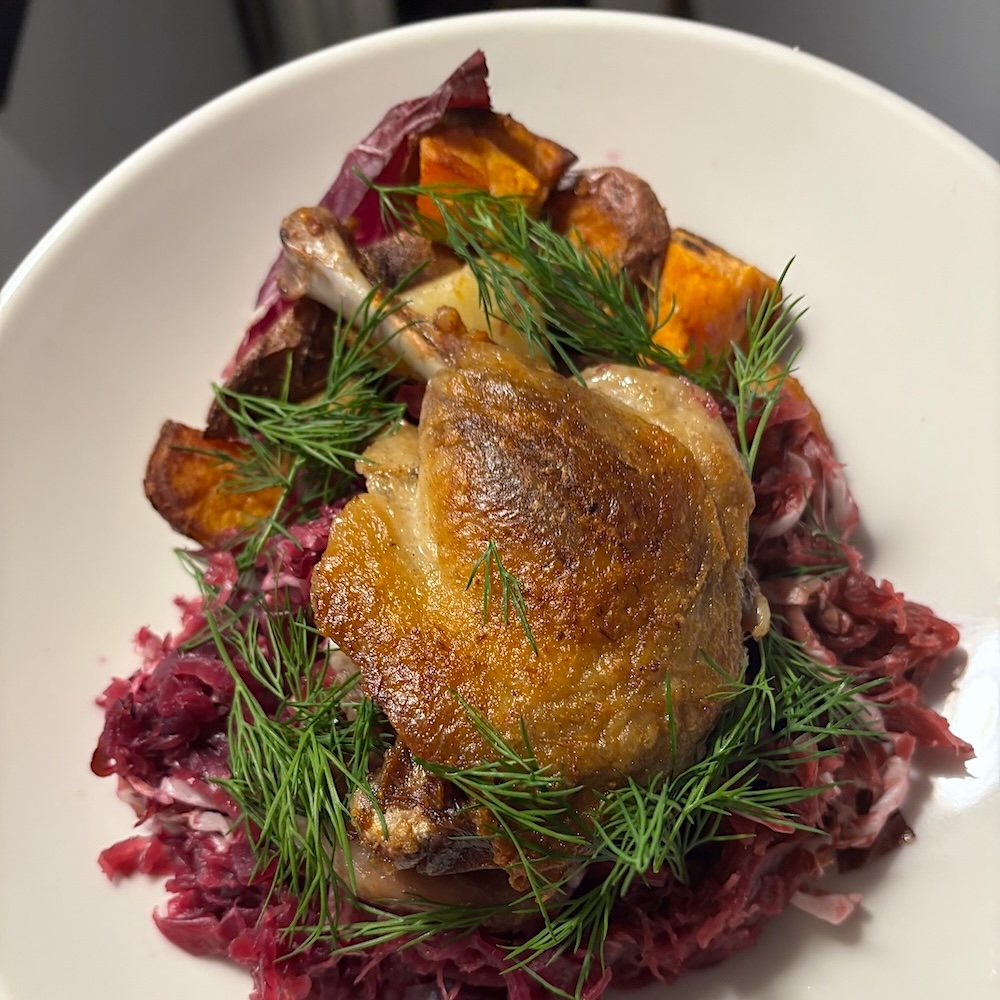
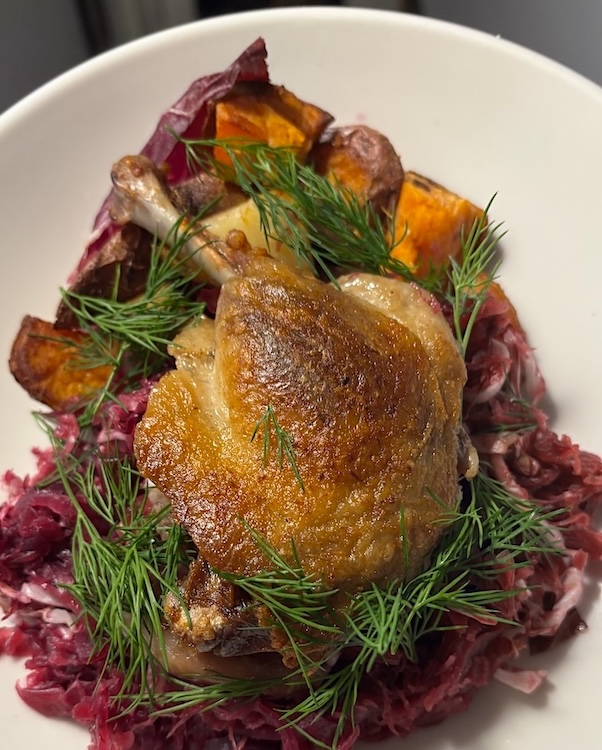
Let’s set the scene: gently cured duck legs, slowly cooked, fully submerged in their own rich fat, until the meat is meltingly tender and practically falling off the bone. Then, just before serving, the legs get a quick sizzle in a hot pan until the paper-thin skin is wonderfully crisp and golden. One leg per person is technically enough…but let’s be honest, you may want more.
Duck confit—confit de canard, if we’re being fancy, is a classic French bistro dish. The word confit (pronounced kon-FEE) refers to the method of slow-cooking meat in fat. Historically, this technique was used to preserve food long before refrigeration. The bonus for modern cooks: duck confit can be made ahead and stored in its fat, meaning future-you will be extremely grateful.
This is one of those dishes that feels wildly luxurious but is secretly low-effort. Let’s get started.
RŪNA Bistro’s Duck Confit for Two (At Home!)
INGREDIENTS:
- 2 duck legs (about 1 pound total)
- 2 tsp salt per pound
- 2 cups of duck fat per pound of duck legs
DIRECTIONS:
- Rub the salt on the legs, cover and refrigerate overnight.
- Preheat the oven to 275°F.
- Rinse with cold water, pat them dry with a paper towel and let them sit at room temperature while you melt the fat on low heat in a pot big enough to hold the two legs and the fat.
- Submerge the legs in the warm fat and place the pot in the oven.
- Cook slowly, for 1.5 – 2 hours, until the meat is tender.
- Remove the pot from the oven and let it cool to room temperature. Store the legs in the fat overnight.
- Next day, warm the fat until it’s soft enough that you can remove the legs.
- Crisp up legs, skin side down on low heat in a pan, finish heating them up in a low heat oven at about 300°F.
- Bon appétit—enjoy every crispy, silky bite.
- Pour yourself a glass of wine. You’ve earned it.
Serving Tips
Duck confit loves simple sides. Think roasted potatoes, red cabbage, a bitter green salad with vinaigrette, or lentils cooked with a little onion and thyme. The richness of the duck pairs beautifully with anything fresh, acidic, or earthy.
And don’t toss that leftover duck fat; use it to roast vegetables, fry potatoes, or elevate just about anything. It’s liquid gold.
Photos courtesy of Clare Hussain RŪNA Bistro
+ + +
The Perfect Pour for Duck Confit

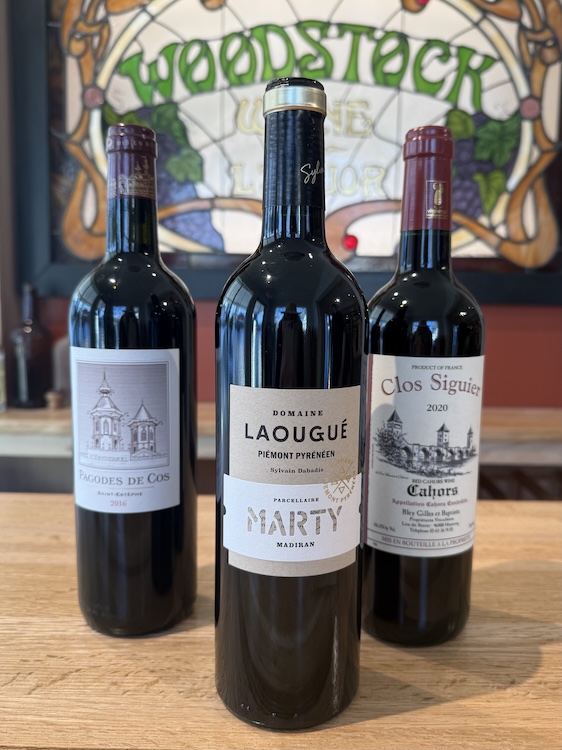
Three soulful French reds, selected by David Pinkard of Woodstock Wine & Spirits
Duck confit is not subtle. The thigh of the duck—salted, then slowly poached in its own fat until melting—is the kind of dish that announces itself the moment it hits the table. The meat is dark and faintly gamey, the edges crisped in a hot pan, the interior lush and silky from its long bath in duck fat. It is richness upon richness.
What it asks for in return is not delicacy, but structure: tannin to grip the palate, acidity to slice through the fat, and dark fruit deep enough to echo that savory depth.
For guidance, we turned to David Pinkard of Woodstock Wine & Spirits, who heads straight for Southwest France and Bordeaux—the ancestral home of both confit and the sturdy reds that love it best. “You want something earthy,” he says. “A little Old World plum. Some leather. Real backbone.”
Here, his trio—low, middle, and high—each a distinct expression of that perfect match. And yes, he admits, he’s partial to one in particular.
A Lovely Introduction: Clos Siguier 2020, Cahors
Earthy, vibrant, quietly complex | Approx. $16.99
Before Malbec became the polished darling of Mendoza, it lived a more rustic life in Cahors. This bottle from Clos Siguier offers that original personality: darker, more restrained, with notes of plum skin, damp earth, and a flicker of spice.
The tannins are present but not aggressive, just enough to hold their own against the confit’s silkiness. Its brightness lifts the richness, keeping each bite from feeling too indulgent. This is the bottle you open when you want authenticity without fuss—a beautifully affordable gateway into the Southwest French tradition.
The Classic Pairing: 2022 Domaine Laougué “Marty,” Madiran
Sturdy, soulful, built for duck | Approx. $25.99
If duck confit has a soulmate, it may well be Madiran. Anchored by the Tannat grape, these wines are famously structured—deep in color, firm in tannin, and unapologetically Old World.
The “Marty” delivers exactly what the dish craves: dark fruit, leather, earth, and that steady, mouth-coating grip that stands up to the duck’s gaminess and rendered fat. There’s something almost primal about the pairing—rustic in the best sense, like a long wooden table in Gascony and a casserole passed hand to hand.
Pinkard doesn’t hesitate when asked for his personal favorite. The Marty is the one he reaches for. “It’s the classic,” he says. “Big, steady, earthy. It just works.”
For a Special Evening: Pagodes de Cos 2016, Saint-Estèphe
Elegant power, layered with time | Approx. $84.99
When the dinner calls for something more celebratory, Pinkard moves north to Bordeaux—specifically Saint-Estèphe, where structure meets polish. Pagodes de Cos, the second label of Cos d’Estournel, carries nearly a decade of age in this 2016 vintage.
Time has softened its edges into layers of blackcurrant, plum, cedar, and tobacco, with tannins that are firm yet refined. It doesn’t overpower the confit; it converses with it. The acidity keeps the palate awake, the fruit mirrors the dish’s savory depth, and the finish lingers long after the last bite. It’s the bottle you open when the table feels special—two candles burning low, plates scraped clean.
When to Open
Duck confit rewards patience, and so do these wines.
- Clos Siguier Cahors: Open about 30 minutes before serving.
- Domaine Laougué “Marty” : Give at least 30-60 minutes of air; decant if you can.
- Pagodes de Cos 2016: Ideally, open a full hour ahead. After years in a bottle, it wants to stretch.
In the end, the pairing is less about price than about harmony. Each of these wines carries the tannin, acidity, and dark fruit needed to meet duck confit where it lives—at that luxurious intersection of rustic tradition and quiet, unforgettable pleasure.
+++
Follow/Connect with Clare at RŪNA Bistro via website | Facebook | Instagram | Inside+Out Spotlight
Read our exclusive interview with Clare Hussain HERE
RŪNA BISTRO
10 Plattekill Ave, New Paltz, NY
845-419-5007
Follow/Connect with David Pinkard at Woodstock Wine & Liquor via website | Instagram | Inside+Out Spotlight
WOODSTOCK WINE & LIQUOR
70 Tinker Street, Woodstock, NY
845-679-2669
Related Posts


Write a Comment
You must be logged in to post a comment.