



Warming the Hearth: An Interior Designer’s Guide to Living Well in Winter
Jennifer Salvemini—interior designer, Creative Director of Studio Hinterland, and guiding force behind Community Hinterland, a Catskills collective of female-identifying artists and makers devoted to creative sisterhood and shared support—has long believed that a home should evolve with the season. In winter, especially, it should become a place that restores us. From her home in Shokan, she invites us in, opening the door to the quiet rituals and thoughtful design choices that shape how she lives through the coldest months.
On the day we speak, nearly two feet of snow has fallen. Driveways wait to be plowed. Walkways remain buried. Cars sit patiently under soft white mounds, waiting to be liberated. Errands feel… aspirational. Winter, in other words, has fully arrived.
This is precisely the moment Salvemini designs for.
“When you’re truly snowed in,” she says, “your house has to work harder for you.” Not in a grim, bunker-like way—more like a capable friend who somehow pulls off a beautiful dinner party when the roads are questionable. Winter isn’t simply about staying warm. It’s about adaptability, rhythm, and learning how to live well within your own four walls when the outside world goes quiet.
Salvemini, whose thinking is rooted as much in anthropology and philosophy as in interiors, approaches homemaking as a kind of ecology: the relationship between objects and bodies, light and mood, sound and nervous system, and the rituals that animate a space. In winter, her Hudson Valley home becomes a responsive organism—supporting entertaining, working, resting, moving, and the occasional deep-winter dance party in sweatpants.
Living Room: Conversation First, Comfort Always
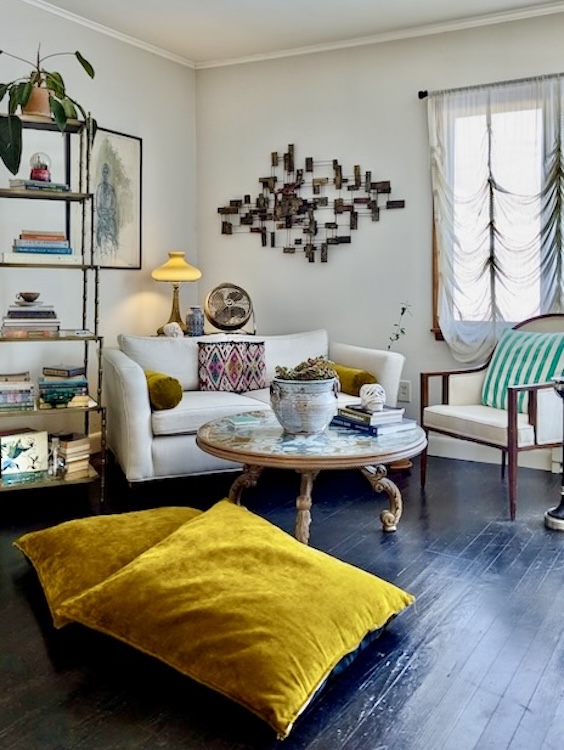
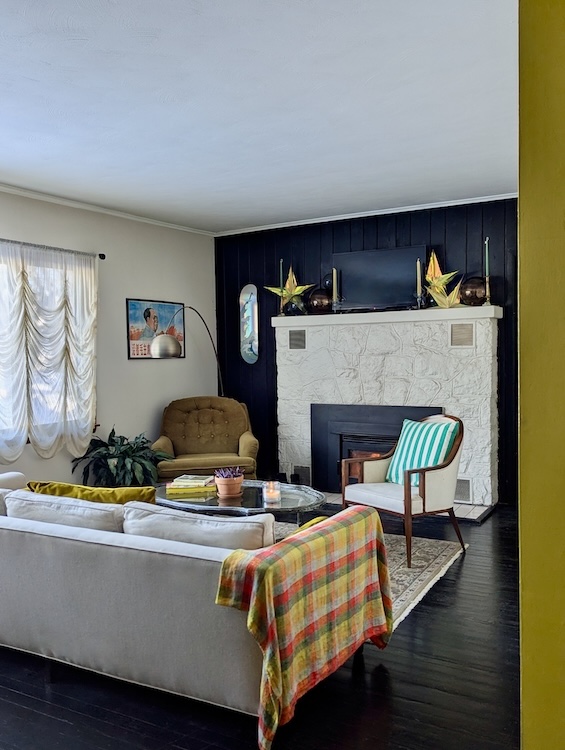
Winter shifts the home’s social center inward, and Salvemini responds by rethinking how furniture relates—not just to screens, but to people.
“Is there an opportunity to rearrange for conversation instead of solo TV watching?” she asks. In her own living room, the answer is happily both.
Her setup is a quiet masterclass in multi-use without ever feeling “multi-use.” There are two seating zones, each designed for real conversation, with the main pieces still oriented toward the television—because winter is also when we watch everything. The sofas face the screen for cozy, side-by-side movie nights. Armchairs and floor cushions turn inward toward the sofas, creating a second gravitational pull that prioritizes actual human engagement.
Nothing is trapped against the walls. Furniture floats, which accomplishes two things at once: it makes the room feel airier—negative space isn’t empty, it’s breathable—and it makes rearranging less dramatic.
“We get so locked into our homes being static,” she says. “But things can always move.”
On a snowy afternoon, that can mean pushing furniture outward so a giant puzzle can sprawl across the floor, or opening the center of the room so kids can build a fort that briefly becomes the main architectural feature. Sometimes a new layout emerges that works better than the one you thought was final.
And then there are the quiet winter heroes: houseplants.
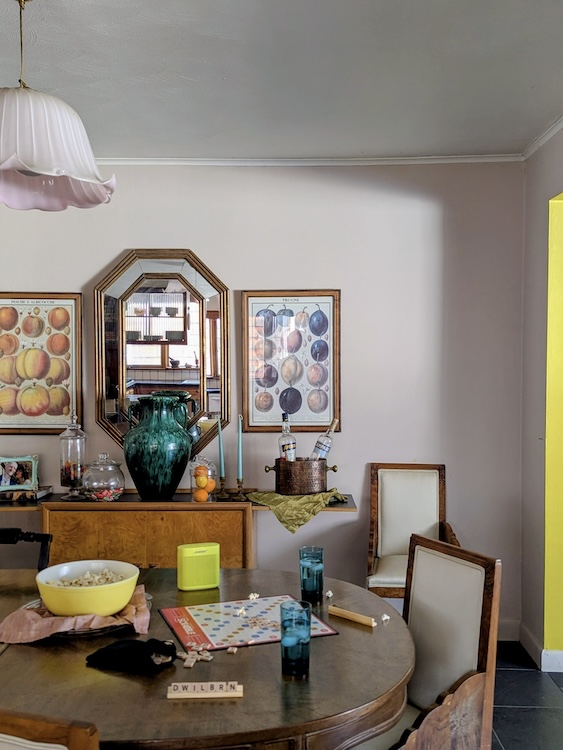

“The easiest way to make a space feel more alive in the dead of winter is to bring some plant babies home,” Salvemini says.
Plants add color, texture, and vitality. They fill space without adding clutter and soften corners the way winter light can’t. If February has you feeling flatlined, she recommends a greenhouse field trip as instant mood medicine—Adams as the local cure; Logee’s in Connecticut as the full, glorious plant-nerd pilgrimage.
For peak coziness, she’s pro one truly excellent faux-fur throw—luxurious enough to make staying put feel like a lifestyle decision. And for those ready to commit fully to hibernation, there’s the now-famous Coma Inducer comforter: lightly weighted, wildly plush, and frequently migrated from bed to couch because once you’re under it, leaving becomes philosophical. “Special thanks to my mother-in-law,” she laughs.
One more winter upgrade, if you’ve got a blank wall and a serious relationship with movie nights: “Lean into a projector moment,” she says. A small shift that turns the room into more of an experience—less TV, more cinema.
Lighting: Productivity by Day, Romance by Night

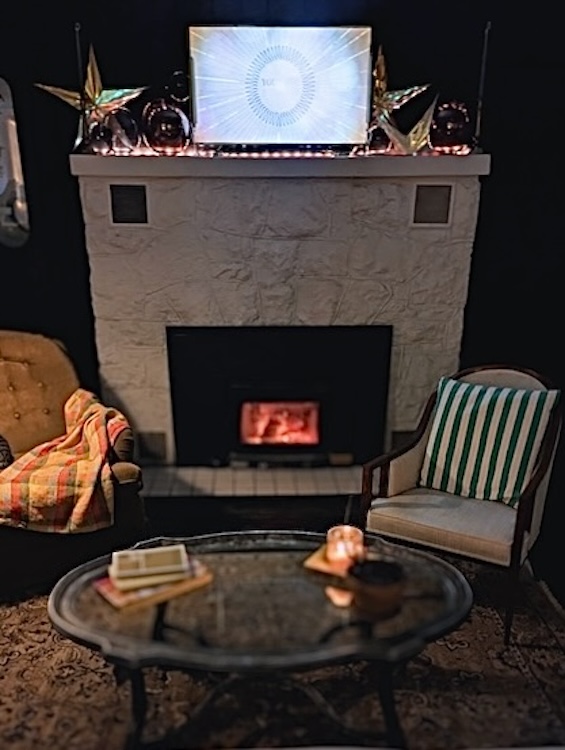
Lighting, Salvemini believes, is the most transformative—and most underused—design tool in winter. Her home runs on a smart system that gives her full control over brightness and temperature, allowing the atmosphere to shift with the day.
That temperature piece matters more than people realize. Even with dimmers, most homes can’t adjust the warmth or coolness of the light itself. In winter, that’s the difference between a house that feels alert and one that feels vaguely cave-like by mid-afternoon.
She often recommends smart bulbs for what she calls “ultimate control”—the ability to shift both luminosity and tone depending on the moment. During the workday, especially in a home office, she cools and brightens the light to mimic daylight and support focus and energy—something many of us crave on overcast afternoons when natural light is scarce.
Then, as evening settles in, she encourages a gentle pivot. Lights lower. Tones warm. The house softens into a more intimate rhythm. Rather than fighting the long stretch of night, she suggests leaning into it—letting rooms glow with warmer, softer light that invites coziness, romance, and calm. Lighting becomes less about utility and more about shaping how a home feels to live in.
Her older house has very few overhead lights, which she considers a feature rather than a flaw. Table lamps and floor lamps do most of the work in bedrooms and living areas; overhead lighting is reserved strictly for task moments—kitchens and bathrooms, primarily. After hours, under-counter lights or a small lamp on the counter can make utilitarian spaces feel layered and quietly atmospheric when they’re off duty.
And yes, there is also a color-light setting for what she calls “necessary deep-winter dance parties in sweatpants.”
Movement + Energy: Designing a Home That Supports the Body
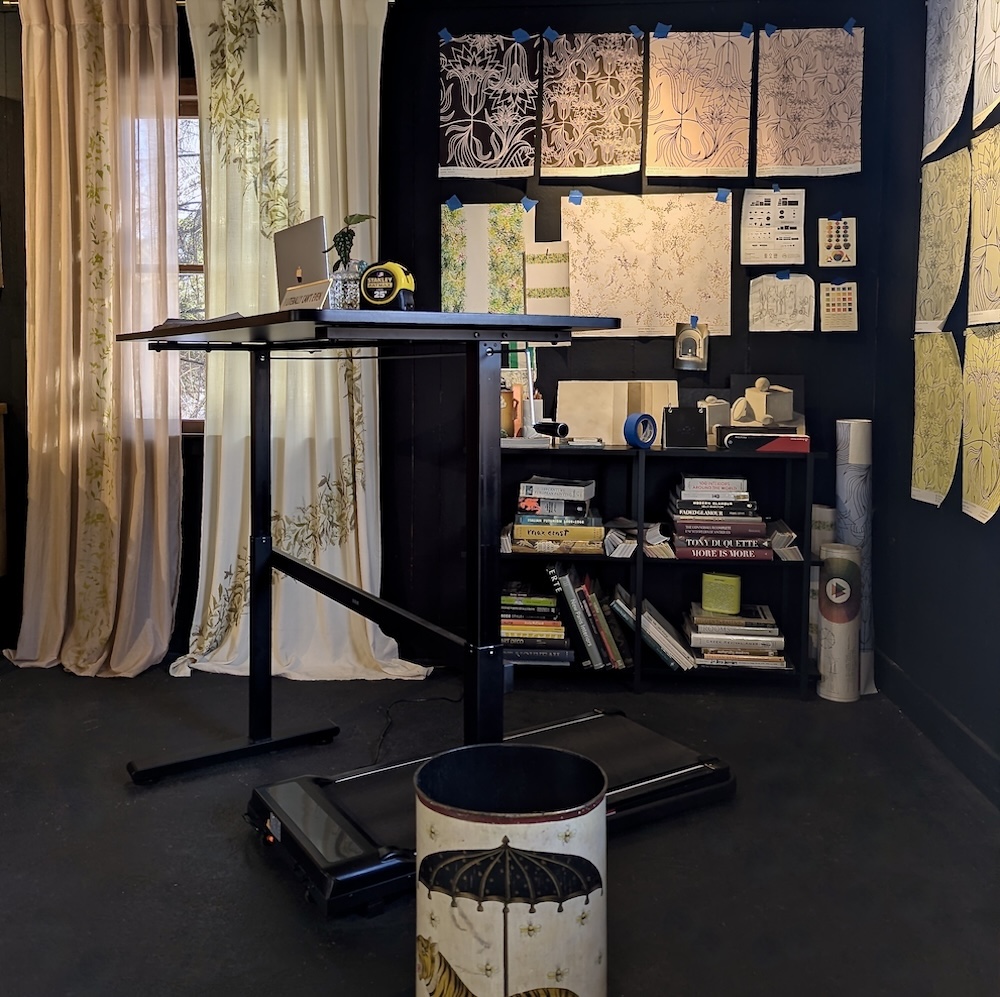
When winter limits outdoor movement, Salvemini designs inward—toward the body.
Her most practical upgrade is a standing desk paired with a walk pad, tucked into a corner between two windows for natural light.
“I realized I was still sending emails from my phone whenever I went to the gym,” she says. “So I thought—why not walk while I work at home?”
Now she can get steps in while answering emails or building mood boards, facing the rest of her showroom so she’s surrounded by beautiful objects instead of a blank wall.
Natural light is essential—both for her work, which relies on nuanced color analysis, and for sustaining a sense of well-being through winter’s shorter days. The setup reflects her larger philosophy:
“Our homes are sacred shelters. But where we really live is inside our bodies. Homes should support that.
She’s also gently ruthless about oversized rooms filled with furniture no one uses—particularly bedrooms. “Please do not work where you sleep,” she says. Energetically, it’s a firm no. If a bedroom has extra space, she’d rather see a yoga mat, a foam roller, and room to stretch than a chair that becomes a laundry purgatory. Winding down, grounding, deep listening—these belong in a bedroom. An office setup does not.
And because atmosphere isn’t only visual, music matters. If you don’t have a home sound system, she suggests investing in an excellent Bluetooth speaker that can move from room to room. Music in the kitchen, music in the bathroom, music while resetting the living room furniture for a puzzle—it becomes an auditory layer that can bring either calm or energy to nearly anything.
“Create conditions for spontaneous dancing,” she says. It’s design advice and mental-health guidance in one sentence.
Kitchen: The Heart of Winter Living
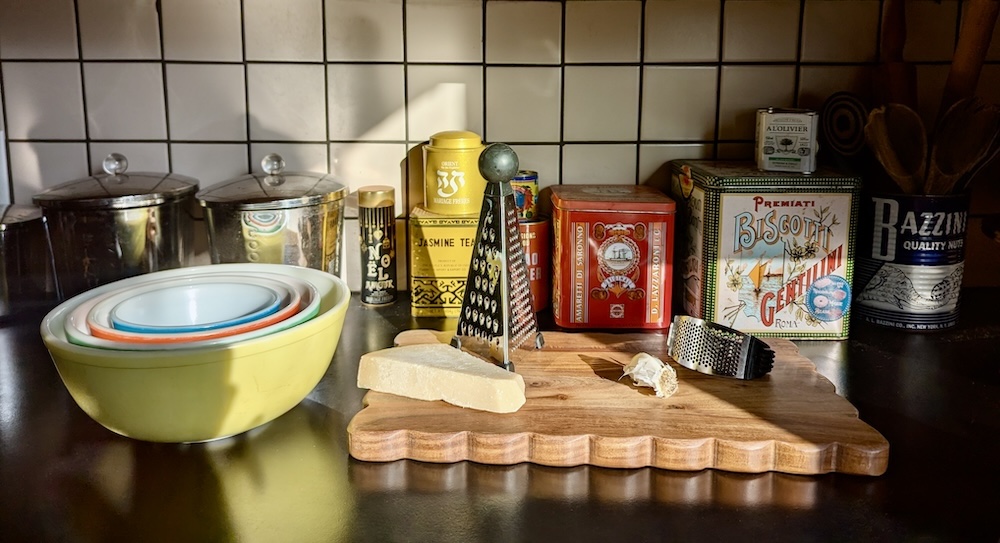
In winter, the kitchen becomes both a sanctuary and a social engine. Cooking is one of Salvemini’s love languages—but shorter days once made it feel like a chore.
Her solution was ritual. Sunday mornings are now reserved for slow, unhurried cooking—alone with her thoughts, plus a podcast or music—and meal prep for the week ahead. That dedicated window restored the therapeutic quality of cooking and freed up weeknights for other forms of decompression.
She’s also an enthusiastic thrift-store shopper for kitchen tools. Cast-iron Dutch ovens, proper knives, clever storage—secondhand isn’t a compromise; it’s a treasure hunt. Her recent finds are persuasive: a handheld garlic crusher that changed her life ($1 at Ulster Habitat for Humanity) and a “sexy” three-sided cheese grater with an ergonomic ball handle ($2 at Aid Tibet Thrift).
“This is an Italian kitchen,” she notes. “These guys get a lot of play.”
Because winter entertaining is real, she keeps small cutting boards and extra paring knives on hand so guests can be happily put to work. Whether you want help or not, the kitchen is where everyone gathers—so you might as well design for that joyful inevitability.
Bedroom + Bathroom: Spaces for Deep Rest and Restoration
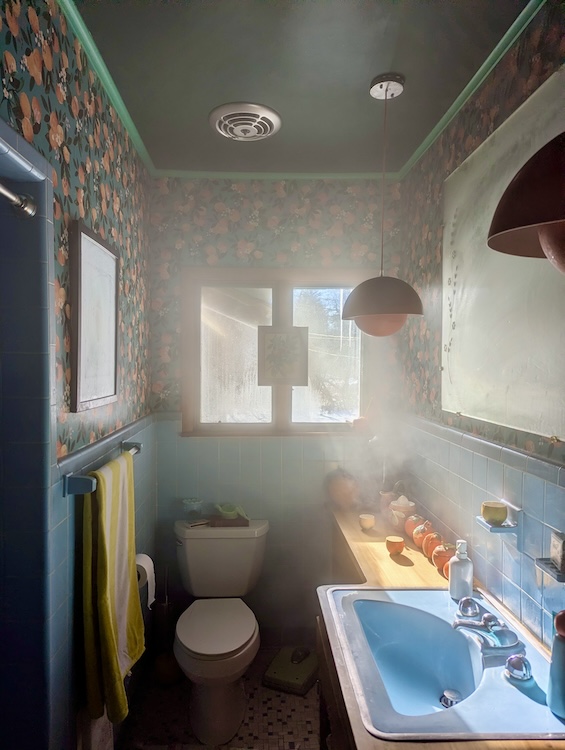
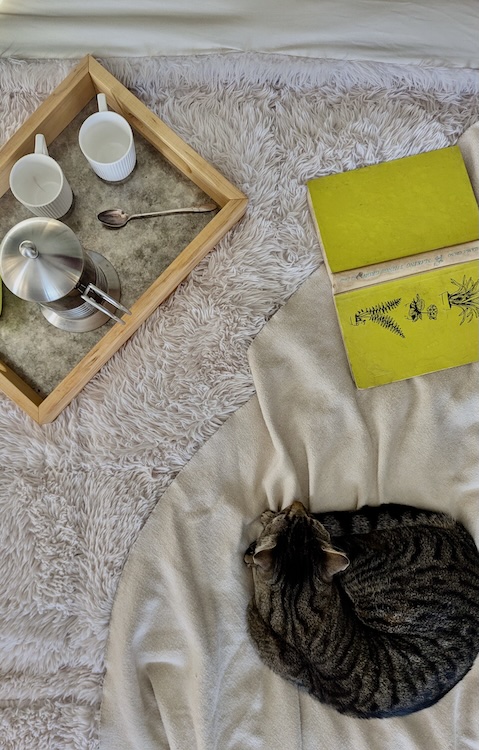
Winter is her favorite time to cosmetically refresh a bedroom—nourishing without requiring major construction drama. Paint is best chosen in winter light.
“Do it during the day when it’s slightly overcast,” she says. “You’ll really see the true color.”
If a shade feels calm and grounding in winter, chances are you’ll love it year-round.
Her approach is straightforward: thrift what can be thrifted—headboards, nightstands, lamps, rugs—then splurge where it counts: bedding and curtains. Layer generously. Prioritize texture. Keep lighting low and warm. Let scent remain subtle and grounding.
Her most beloved winter hack is spa-grade and hilariously low-budget: turning the bathroom into a makeshift sauna. A small space heater goes on. The shower runs hot for a few minutes. Lights off. A few drops of eucalyptus oil. Suddenly, a routine shower becomes far more enjoyable—and genuinely therapeutic.
Entryway: A Seasonal Landing Strip That Keeps Chaos Contained

Without a mudroom, winter chaos spreads quickly. Her answer is the seasonal landing strip—a temporary setup that catches life before it spills into the rest of the house.
A large jute or bristly mat. A rubber or metal boot tray. A freestanding coat rack—bonus points for a beautiful vintage brass one. A stool or folding chair to help with clumsy snow gear. Baskets for hats, scarves, and gloves so the house doesn’t become a soft avalanche.
The guiding principle: everything should be freestanding, easy to store when the season ends, and not so bulky that it hijacks the room if your front door opens directly into it. A quick Facebook Marketplace search, she notes, often turns up surprisingly attractive coat racks worth an afternoon drive.
“These pieces serve the season,” she says. “Then they rest.”
Windows: Let the Light In, Keep the Warmth Close
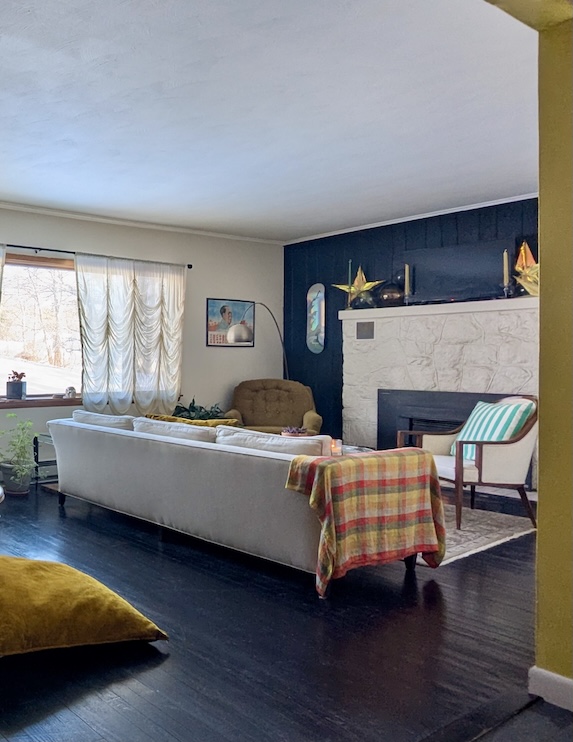

When possible, Salvemini prefers sheers in winter to maximize daylight and maintain a visual connection to the outside world.
“Any light?” she says. “Let it in.”
But in older homes where drafts are a real character in the story, heavier fabrics step in: velvet, canvas, chenille, damask, brocade, woven or felted wool—dense materials that help soften a room’s chill.
Her installation advice is practical and preserving: avoid mounting curtain hardware into original wood window trim. Install it into drywall instead—patching drywall is far easier if you ever change things, and historic details remain intact. Place the rod between the window frame and the ceiling—midway is usually safe—and extend it wider than the window so the curtains overlap the edges. Floor-to-ceiling drapes add drama and exaggerate height; the right proportions make a room feel taller, warmer, and more complete.
“It’s all meant to be swappable,” she says. “Nothing permanent. Just responsive.”
The Takeaway: A Home That Responds to How You Actually Live
In Salvemini’s world, a winter home is less about styling than about support. It responds to the realities of the season—snow days, homebound work, drawn-out evenings—offering spaces for rest, movement, and small daily pleasures that keep life feeling expansive even when it’s lived indoors.
“Go in hard on how you’re actually living,” she says. “Whatever winter asks of you—answer it thoughtfully.”
Follow/Connect with Jennifer Salvemini via Website | Instagram | Inside+Out Spotlight
Follow/Connect with Studio Hinterland via Website | Instagram | Inside+Out Spotli
Photos courtesy of Jennifer Salvemini
+ + +
Click HERE to see all of our exclusive interviews with the amazing folks who proudly call the Hudson Valley home.
Related Posts


Write a Comment
You must be logged in to post a comment.